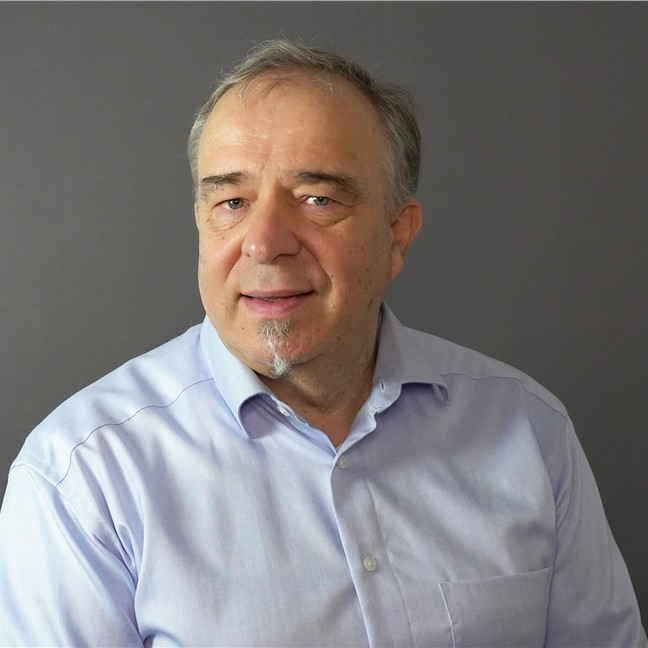
Forskningssjef
Wolfgang Leister
- Avdeling Anvendt IKT-forskning
- Mobiltelefon +47 928 95 500
- Telefonnummer +47 22 85 25 78
- E-post wolfgang@nr.stage.dekodes.no
Vis beskrivelsesinformasjon
Skjul beskrivelsesinformasjon
Wolfgang Leister forsker innenfor digital transformasjon, digital inkludering, sosiale roboter, brukeropplevelse (UX, QoE), smarte informasjonssystemer, tingenes internett (IoT), e-helse-systemer, multimedia and datanettverk, mobile systemer, datagrafikk, åpne data og kildekoder. Han har også arbeidet innen områdene datagrafikk (siden 1982), ikke-fotorealistisk bildegenerering (1992-1998), data-holografi (1988-1990) og målesystemer (1992-1997).
Leister er utnevnt som IARIA fellow, International Academy, Research, and Industrial Association.
Utdanning
- 1992 – Dr.rer.nat., Disputation 26.06.1991. “Geometrisches Modellieren durch interactive Rekonstruktionsmethoden” (Geometrisk modellering gjennom interaktive rekonstruksjonsmetoder), Institut für Betriebs- und Dialogsysteme, Fakultät für Informatik, Universität Karlsruhe (TH), now: Karlsruhe Institute of Technology, Tyskland.
- 1987 – Diplom-Informatiker; Avhandling: “Filmerzeugung durch Raytracing” (Generering av animasjoner med raytracing-metoden), Institut für Betriebs- und Dialogsysteme, Fakultät für Informatik, Universität Karlsruhe (TH), Tyskland
Yrkeserfaring
Norsk Regnesentral
- 2023 – forskningssjef, DART
- 2020 / 2021 – 2022 fungerende forskningssjef, DART
- 2011 – 2020 / 2021 assisterende forskningssjef
- 1997 – seniorforsker / sjefsforsker
METRONOR
- 1992 – 1997 utviklingsingeniør, Asker, Norway
Universität Karlsruhe
- 1986 – 1992 forsker, Institut für Betriebs- und Dialogsysteme, Tyskland.
Kurs og forelesninger (utvalg)
- 2009-2015 INF5780: Open Source, Open Collaboration, and Innovation, Institutt for Informatikk, Universitetet I Oslo, Norge
- 2001-2011 INF5081: Coding and Transmission of Multimedia Content, Institutt for Informatikk, Universitetet I Oslo, Norge
Vitenskapelig arbeid
- 25 tidskriftsartikler
- 45 bokkapitler og vitenskapelige presentasjoner på internasjonale konferanser.
- Veiledning av tre PhD-studenter
Prosjekter
- Digital inkludering
- Universell utforming (UU)
Bedre hjelp til synshemmede

- Digital sikkerhet og personvern
- Datasikkerhet og personvern
Demokrati i helse
Publikasjoner
- 308 publikasjoner funnet
Leister, Wolfgang. (2025).
Why is it important for Norway to host the North European Cyber Days. ECSO, cyberhive, women4cyber, venturenet, necc, Norsk Regnesentral, NESIOT, Norwegian Cyber Cluster, NORCICS, NTNU
NVA
Annen presentasjon
Simon-Liedtke, Joschua Thomas; Fuglerud, Kristin Skeide; Skråmestø, Eva Elida Singsaas og Leister, Wolfgang. (2024).
Mastering Gesture-Based Screen Readers on Mobile Devices - Exploring Teaching and Practice Strategies.
Vis sammendrag
Gesture-based screen readers like VoiceOver or TalkBack provide visually impaired users with a means to interact with digital content. However, there is a significant lack of both strategies and resources for teaching the use of these screen readers, and standardized teaching guidelines are notably absent.
Furthermore, there is no free, universally designed, and accessible app for practicing gestures in mobile screen readers. This study aims to identify best practice strategies for teaching and practicing the use of gesture-based screen readers among visually impaired users, based on observations from an IT course directed at visually impaired individuals. Moreover, we present common challenges related to usability, attitudes, emotions, technical aspects, and user guidance and education, as well as key traits and facilitators for learning gesture-based screen readers. Lastly, we assess the feasibility of an app to practice gestures and propose a framework for a gesture practice app to enhance user accuracy and patience.
Fuglerud, Kristin Skeide; Leister, Wolfgang og Vidal, Juan Carlos Torrado. (2024).
Conference Compendium of the Seventh International Conference on Universal Design (UD2024), Shaping a Sustainable, Equitable and Resilient Future for All.
Vis sammendrag
Universal design, inclusive design, design for all, innovation for all, and accessibility are some of the concepts aimed at making products, environments, and services usable and accessible for diverse users, regardless of ability, age, or background. While these terms imply common goals, they each offer distinct approaches to creating inclusive solutions. This compendium comprises of 48 papers, abstracts, and posters presented at UD2024, the 7th International Conference on Universal Design, held from 20 to 22 November 2024 in Oslo, Norway. It can be seen as an addition to the conference proceedings. Although the UD conference series uses the term universal design, it welcomes researchers and practitioners from the other disciplines designing for diverse user groups in the hope that this will result in a wider spectrum of viewpoints and will help to unite these various approaches to advance the field. The contributions are grouped into six chapters, covering design approaches, theoretical perspectives and socio-economic benefits; children, learning environment, and education; universal design in the built environment; inclusive tourism and sustainable communities; digital inclusion, communication and organisation; as well as universal design of ICT and technical aspects.
Leister, Wolfgang. (2024).
Usable Security in Healthcare: Advance or Retreat. CybAlliance
NVA
Faglig foredrag
Fuglerud, Kristin Skeide; Leister, Wolfgang og Vidal, Juan Carlos Torrado. (2024).
Universal Design 2024: Shaping a Sustainable, Equitable and Resilient Future for All. Proceedings of the Seventh International Conference on Universal Design (UD2024), Oslo, Norway, 20-22 November 2024.
NVA
Vitenskapelig antologi/konferanseserie
Vis sammendrag
This book presents the proceedings of UD2024, the 7th International Conference on Universal Design, held from 20 to 22 November 2024 in Oslo, Norway.
Dahl, Fredrik Andreas; Eikvil, Line; Tvete, Ingunn Fride; Lison, Pierre; Pilán, Ildikó; Fuglerud, Kristin Skeide og Leister, Wolfgang. (2023).
Helse-effektivisering - et mulig satsningsområde for NR.
NVA
Rapport
Leister, Wolfgang; Kristoffersen, Thor O. og Schulz, Trenton. (2022).
SoundVision D4.4: Indoor Navigation and Location Finder.
NVA
Rapport
Vis sammendrag
This document presents details from the implementation of the Location Finder functionality. We made a short survey of indoor-map formats and adjacent software that could be used for modelling. Further, we developed the database for the navigation finder, the data format, as well as how to create models. We propose and describe the Soundvision Indoor Routing Format (SIRF) in this document.
The location finder makes use of a map to facilitate the navigation functionality. The navigation is supposed to be performed indoors. The navigation accuracy will be ca. 1 m, so that small details in a room are not necessarily mapped.
Boudko, Svetlana og Leister, Wolfgang. (2022).
Bilateral Bargaining for Healthcare Data Sharing.
Vis sammendrag
The healthcare market demands flexible, and secure solutions for personal health data sharing. For this purpose, we developed a distributed multi-agent system that reinforces a negotiable right management environment. We propose a bilateral bargaining mechanism that facilitates computational negotiation between patients and healthcare stakeholders. The mechanism is evaluated using both open and sealed bids. We show that agents reach an agreement within a feasible number of rounds, even if their bids are kept confidential.
Schulz, Trenton og Leister, Wolfgang. (2022).
SoundVision D1.3 Technical Documentation for Making Models.
NVA
Rapport
Vis sammendrag
This is a summary of what is needed to be done to create the models that are used in the SoundVision project. This includes hardware, software, gathering datasets, and workflows for how to create the models. The documentation should make it possible to start from scratch and creating models quickly (although training the models may take some time depending on the hardware).
Schulz, Trenton; Leister, Wolfgang og Mavrodiev, Stefan. (2022).
SoundVision D1.3 Technical Documentation V3.
NVA
Rapport
Vis sammendrag
This document is a summary of the technical components and the documentation for creating models used in the SoundVision project.
Schulz, Trenton; Leister, Wolfgang; Dineva, Doroteya og Zhelev, Zhelyazko. (2022).
SoundVision D6.1: Recruitment of focus group.
NVA
Rapport
Vis sammendrag
This document collects the various bits of information around the recruitment of focus groups for the SoundVision project.
Schulz, Trenton og Leister, Wolfgang. (2022).
SoundVision D4.6 Read out loud Functionality.
NVA
Rapport
Haugen, Bjørn K; Schulz, Trenton; Leister, Wolfgang og Kristoffersen, Thor O.. (2022).
SoundVision – User Evaluation Report from Norway.
NVA
Rapport
Vis sammendrag
This document is a collection of different deliverables in the SoundVision project for user evaluation and focus groups. The document contains the deliverables:
D1.7 Report from focus group work, trials,
D6.2 User testing, 1st round,
D6.3 User testing, 2nd round, and
D6.4 User testing 3rd round.
The deliverables are presented together for ease of reading, but each of these deliverables is presented in their own section.
The user evaluation and focus groups shows that people are interested in the concept of the device and the app, but there are many things that must be improved in a future version.
Schulz, Trenton og Leister, Wolfgang. (2022).
SoundVision D4.1: Machine learning models for mobile device.
NVA
Rapport
Vis sammendrag
This is a summary of the information for the work done for the first revision of the model for the SoundVision project.
Leister, Wolfgang. (2022).
Personal health, Engagement, Universal Design, and Usability. European Federation of Medical Informatics (EFMI), NTNU, NR
NVA
Faglig foredrag
Leister, Wolfgang. (2022).
Keynote: Assessing and Measuring Human Factors - Trends and Developments. IARIA
NVA
Vitenskapelig foredrag
Vis sammendrag
How can we measure people’s engagement with a program, a museum exhibition, and a hike through nature? The talk will be about assessing and measuring human factors using different methods in different contexts beyond measuring the usability of computer programs on a desktop computer. We report on how to assess user engagement for exhibits in science centres and museums. This method for measuring engagement is robust and can be extended to cover teaching scenarios using a robot as an assistant, a planned app for pensioners about cultural experiences, and engagement for organized hiking tours. Engagement is not the only factor that is important in museums; it is also important to know how accessible an exhibition is to people with disabilities. Indeed, assessing technologies such as social robots and extended reality are still not solved for people with disabilities. Finally, the ongoing Covid-19 pandemic poses challenges to assessment of human factors, forcing researchers to think in new ways. We can find many adjustments to research in recent articles on human factors to accommodate the limitations that occurred from the pandemic.
Hannay, Jo Erskine; Fuglerud, Kristin Skeide; Leister, Wolfgang og Schulz, Trenton. (2022).
Scenario Design for Healthcare Collaboration Training Under Suboptimal Conditions.
Vis sammendrag
Healthcare today usually consists of various services covering various parts of the total healthcare of a region or country. These services are required to coordinate and collaborate, often using procedures and IT collaboration tools that may not be designed for interoperating across the evolving wider landscape of healthcare services. We posit that it is necessary to train personnel in collaboration skills using whatever infrastructure is in place. To this end, we present design principles for simulation-based collaboration training scenarios that emphasizes the inclusion of suboptimal infrastructure elements. We applied the principles in a co-creational workshop with healthcare stakeholders from a hospital and surrounding municipalities in Norway where we discussed cases where collaboration training is perceived as critical. We elicited five training vignettes concerning the general case of detecting, and following up on, clinical deterioration in a patient at home or in a nursing home. We found that the design principles spurred highly relevant discussions among participants and that novel ideas for collaboration training were brought forth on the basis of these principles. We conclude that there is a potential in using these principles for eliciting training vignettes that address the actual situation more accurately.
Hannay, Jo Erskine; Fuglerud, Kristin Skeide; Leister, Wolfgang og Schulz, Trenton. (2022).
Scenario Design for Healthcare Collaboration Training Under Suboptimal Conditions. HCI International Conference
NVA
Vitenskapelig foredrag
Kristoffersen, Thor O.; Simon-Liedtke, Joschua Thomas og Leister, Wolfgang. (2021).
Research Challenges in SSI in Secured Digital Infrastructures.
NVA
Rapport
Vis sammendrag
The report explores the current state-of-the-art in Self-Sovereign Identity (SSI) and addresses the remaining important research challenges, both with respect to governance and technological aspects of the four layers of the SSI stack. Further, the report outlines the use of SSI in onboarding applications and identity proofing in connection with video streaming.
Halbach, Till; Schulz, Trenton; Leister, Wolfgang og Solheim, Ivar. (2021).
Robot-Enhanced Language Learning for Children in Norwegian Day-Care Centers.
Vis sammendrag
In a case study, we transformed the existing learning program Language Shower, which is used in some Norwegian day-care centers in the Grorud district of Oslo municipality, into a digital solution using an app for smartphones or tablets with the option for further enhancement of the presentation by a NAO robot. The solution was tested in several iterations and multiple daycare centers over several weeks. Measurements of the children’s progress across learning sessions indicated a positive impact of the program using a robot as compared to the program without a robot. In situ observations and interviews with day-care center staff confirmed the solution’s many advantages, but also revealed some important areas for improvement. In particular, the speech recognition needs to be more flexible and robust, and special measures have to be in place to handle
children speaking simultaneously.
Keywords: social robot; mobile app; e-learning; language education; kindergarten; preschool; case study
Šteinbergs, Juris; Leister, Wolfgang; Zaharāne, Ilze og Jātnieks, Jānis. (2021).
Panel discussion: "Norway grants: Welfare technologies for an inclusive society". Investment and Development Agency of Latvia (LIAA)
NVA
Poster
Leister, Wolfgang; Schulz, Trenton Wade; Hannay, Jo Erskine; Simon-Liedtke, Joschua Thomas; Tjøstheim, Ingvar; Fuglerud, Kristin Skeide; Halbach, Till; Boudko, Svetlana og Stolpe, Audun. (2020).
Aspects of Digitalisation.
NVA
Rapport
Vis sammendrag
This document describes the work performed in the project GB-DIGITALISERING 2020 Covid19, which is funded by the Research Council of Norway. The project identified technological barriers and obstacles for digitalisation in today’s society and provided ideas on how to mitigate these. The use of AR/VR/MR technologies, social robotics, and wide use of data from sensors and devices in the IoT in diverse application areas are important technologies to make migration from analogue to digital solutions possible. The project results will be used to support the industry and the public sector to mitigate barriers related to properties of usability, universal design, privacy, security, personalization of services, user engagement, and others.
Leister, Wolfgang; Halbach, Till; Schulz, Trenton Wade og Østvold, Bjarte M.. (2020).
Security & Privacy in Social Robots.
NVA
Rapport
Vis sammendrag
This note reviewed security aspects of social robots with an emphasis on Nao. We also looked at aspects to how and where to process data from sensors, that are necessary for the operation of the robot, such as a microphone, camera, and so on. Further, we presented elements that could be used for an evaluation of social robots. Such evaluation includes security and privacy, as well as other aspects such as usability and quality.
Mitev, Evgeni; Karamanski, Pancho; Dineva, Doroteya; Nakova, Anita; Haugen, Bjørn K og Leister, Wolfgang. (2020).
SoundVision D1.1: Project Vision Consolidation.
NVA
Rapport
Vis sammendrag
The purpose of the D1.1 "Project vision consensus" document is to strengthen the common understanding of the project vision and the overall aims and objectives of the project.
SYNERGIA leads the process of creating this document, ensuring the end result be aligned with the needs of the visually impaired people. All partners contribute with valuable information so that the document gathers data and user needs specifications for all European countries.
The Project Vision document will contribute to the work in all other tasks in the project.
The Vision consensus document defines the basic and common understanding of the activities to be carried out in the project SoundVision, including a conceptual definition, planning and further documentation of the new technologies and products.
The goal of this deliverable is to set the conceptual purpose of the project, thus answering the general question why a new product development of device for blind and partially sighted people is needed. It will be used by all partners to stay on the same page throughout the entire project as well as involving the target audience of people with visual impairments in the process of creating the best technical solution in line with their everyday needs.
To achieve this goal, this Project Vision Consensus Document provides information about the following key points:
- Definition of constrains and limitations
- Real-life use cases of the planned devices by visually impaired and blind people
- Integration between the overall goals of the project and the defined constraints and limitations.
- Description of devices
- Stakeholders and users
Leister, Wolfgang; Tjøstheim, Ingvar; Joryd, Göran; Heggelund, Håvard Imerslund og Andersson, Jan Alfred. (2019).
Strengthening engagement in science understanding with learning trails.
Vis sammendrag
The Norwegian Museum of Science and Technology has developed a learning concept for school classes in science centres named “learning trails”. In this concept, groups of students perform a series of thematically related experiments with installations in the science centre. The learning trails are designed to support the generic learning outcomes for science centre visits. We argue that the previously developed Engagement Profile can be used to translate exhibit properties into both media forms and generic learning outcomes for such learning concepts. Further, we implemented the learning trails in two modes: one mode used paper-based content to guide the students, while the other mode supported the use of tablet PCs where engaging content is triggered when the students approach the location of an experiment in the learning trail. We studied the engagement factors of the learning trails and observed how school classes use these. In a study with 113 students from lower secondary school (age 16), they answered short questionnaires that were integrated into the implementation of the learning trails. While the concept of the learning trails was evaluated positively, we could not find significant differences in how engaging the two implemented modes were.
Tjøstheim, Ingvar; Leister, Wolfgang og Waterworth, John A.. (2019).
Telepresence and the Role of the Senses.
Vis sammendrag
The telepresence experience can be evoked in a number of ways. A well-known example is a player of videogames who reports about a telepresence experience, a subjective experience of being in one place or environment, even when physically situated in another place. In this paper we set the phenomenon of telepresence into a theoretical framework. As people react subjectively to stimuli from telepresence, empirical studies can give more evidence about the phenomenon. Thus, our contribution is to bridge the theoretical with the empirical. We discuss theories of perception with an emphasis on Heidegger, Merleau-Ponty and Gibson, the role of the senses and the Spinozian belief procedure. The aim is to contribute to our understanding of this phenomenon. A telepresence-study that included the affordance concept is used to empirically study how players report sense-reactions to virtual sightseeing in two cities. We investigate and explore the interplay of the philosophical and the empirical. The findings indicate that it is not only the visual sense that plays a role in this experience, but all senses.
Cooney, Martin Daniel og Leister, Wolfgang. (2019).
Using the Engagement Profile to Design an Engaging Robotic Teaching Assistant for Students.
Vis sammendrag
We report on an exploratory study conducted at a graduate school in Sweden with a humanoid robot, Baxter. First, we describe a list of potentially useful capabilities for a robot teaching assistant derived from brainstorming and interviews with faculty members, teachers, and students. These capabilities consist of reading educational materials out loud, greeting, alerting, allowing remote operation, providing clarifications, and moving to carry out physical tasks. Secondly, we present feedback on how the robot’s capabilities, demonstrated in part with the Wizard of Oz approach, were perceived, and iteratively adapted over the course of several lectures, using the Engagement Profile tool. Thirdly, we discuss observations regarding the capabilities and the development process. Our findings suggest that using a social robot as a teaching assistant is promising using the chosen capabilities and Engagement Profile tool. We find that enhancing the robot’s autonomous capabilities and further investigating the role of embodiment are some important topics to be considered in future work.
Leister, Wolfgang. (2019).
Strengthening Tourists’ Engagement in Guided Hiking and Trekking.
Vis sammendrag
Many providers in adventure travel promote organised hiking and trekking tours. Such guided tours shall be engaging for the tourists and evoke positive attitudes towards enjoying nature. We present the Trekking Engagement Profile as a tool to evaluate engagement factors of such guided tours, based on engagement research performed in a different domain, namely evaluating engagement in museums and science centres. This tool shall strengthen the guides’ soft skills and enable them to increase engagement during an ongoing arrangement. For instance, the Trekking Engagement Profile can be applied when tourists indicate that the quality of a guided tour is not entirely to their liking. We show the viability of using the Trekking Engagement Profile in a small study with guides and participants of trekking tours offered by the Norwegian Trekking Association. Further, we offer guidance and charts to promote its practical use.
Boudko, Svetlana og Leister, Wolfgang. (2019).
Building Blocks of Negotiating Agents for Healthcare Data.
Vis sammendrag
The healthcare market demands advanced, flexible, and secure solutions for personal health data sharing. In our paper, we present preliminary work that proposes a distributed infrastructure of negotiating agents for the healthcare domain. This infrastructure will support healthcare stakeholders to share and access patient health data in a secure way, thus providing benefits for patients and their
treatment. Distributed ledger technologies and smart contracts can be considered as a basis for negotiations between distributed agents that carry health-related data. We present an overview of related work and outline the research methodology.
Leister, Wolfgang og Tjøstheim, Ingvar. (2018).
Which Generation Shows the Most Prudent Data Sharing Behaviour? University of Amsterdam
Vis sammendrag
We report from a study performed in ten European countries, where we asked about attitudes and behaviour towards data sharing behaviour. We looked into the differences between members of age groups. We find that there are more similarities than differences between the age groups, with the exception of young people more often tending to use fake information for privacy reasons. When analysing whether users change privacy settings as an indicator for awareness, we find that both the younger and the older users have lower awareness than the members of the middle-aged. The use of learning and practising tools seems the right way to increase the privacy and data sharing awareness of citizen.
Leister, Wolfgang; Aursand, Peder; Kristoffersen, Thor O.; Ravneberg, Bodil og Øvsthus, Knut. (2018).
Sluttrapport: Robotdusj som et løft i offentlig sektor.
NVA
Rapport
Habib, Kashif; Leister, Wolfgang; Snekkenes, Einar Arthur og Balasingham, Ilangko. (2018).
Context-Aware Adaptive Authentication for the IoT in eHealth.
NVA
Doktorgradsavhandling
Vis sammendrag
The Internet of Things (IoT) presents a concept of smart world around us, where things are trying to assist and benefit people. Patient monitoring outside the hospital environment is one case for the IoT in healthcare. The healthcare system can get many benefits from the IoT such as patient monitoring with chronic disease, monitoring of elderly people, and monitoring of athletes fitness. The IoT in eHealth aims to assist the existing healthcare system by monitoring the vital signs of patient’s health data. The IoT in eHealth can be established though the integration of wireless body area network, communication infrastructure, and the healthcare enterprises. The dynamic and heterogeneous environment of the IoT may facilitate the patient with advanced mobility options. However, security-related problems may obstruct the development of such a comprehensive patient monitoring system. This interface allows them to have a virtual existence which transcends their real existence. The IoT may offer highly connected digital world where patients will be fenced by tiny smart things. In such an environment, the actions taken by things to comfort a patient may have ethical implications as well. While standards and technologies are continuously developed for the IoT, the ethical aspects of these developments must be addressed and it could be incorporated in the system development life cycle. We concluded that he claimed benefits of the IoT may not be realised, unless ethical implications of such claims on people, society, and environment are justified. Further, there is a strong need to formulate solutions to potential ethical issues in the IoT before it is irreversibly adapted by society. While the IoT is a dynamic network of interconnected things, concepts for adaptive security can be applied to this dynamic environment. However, the question is whether adaptive security mechanisms do meet the specific security requirements for the IoT based platform. We found that adaptive security mechanisms can be a better choice to secure dynamic and heterogeneous computing systems in the IoT. We concluded that the characteristics, capabilities, and requirements of the IoT create a dynamic resource constrain environment that need adaptive features for functionalities and security. The existing IoT models do not focus on structuring adaptive features in layers. Moreover, these reference models address the security at each layer independently and do not depend on the other layers that can be dealt with a cross layer design approach. While assessing the security of a patient monitoring system, it is necessary to realise that it may not be enough to only look into the security related aspects of the body area network. Instead, the overall patient monitoring system should be treated as a connected and integrated eHealth system. The important security issues that can put the eHealth system at risk are analysed, identifying specific security goals, requirements, and vulnerabilities for the IoT in eHealth. We highlight important assets, vulnerabilities, and threats that can harm assets and disrupt eHealth systems. We describe adaptive security and introduce a concept of adaptive security countermeasures for the smart IoT in eHealth. While making a security decision, the security mechanisms should incorporate security requirements, threats, and attacks based on the patient’s location and environmental context. While remote patient monitoring may improve healthcare, patient authentication is a challenge in this scenario. We propose a novel authentication framework based on biometric modalities and wireless device radio fingerprinting. The framework is capable of verifying that the monitored data belongs to the actual patient during the entire session, it also ensures the integrity and trust of the received data. We analyse our framework in view of some issues for the IoT in eHealth such as context and location awareness, resource constraints, and dynamic environment. The framework is resource and energy efficient requiring no extra processing for authentication purpose except the initial pre-processing of biometric and radio fingerprinting templates. While suffering from an extraordinary medical condition during the remote monitoring session, the patient’s location can be determined using smartphone radio fingerprints. Mechanisms that are not context-aware can be inadequate for the IoT due to its dynamic and heterogeneous environment. The context information can be used to reconfigure security mechanisms and adjust security parameters. The contextual information can be integrated into various security mechanisms such as authentication, access control, encryption, etc. The context-aware security is the dynamic adjustment of security policy based on the context. We present the context-awareness techniques for authentication and access control mechanisms. We discuss the concepts of context, contextawareness, and context based security and highlight contextual attributes that can be used to support and enhance authentication and access control mechanisms for the IoT. This thesis focus towards the context-aware adaptive authentication for the IoT in eHealth and provides several opportunities for further development on it as future work. The authentication framework for the IoT in eHealth that combines biometric modalities and smartphone radio fingerprinting is in its early stage of development, so we present several aspects that serve as a basis for further amplification.
Leister, Wolfgang. (2018).
Workflow-Assisted Services for Pre-Hospital Care. Sykehus Innlandet
NVA
Faglig foredrag
Fuglerud, Kristin Skeide; Leister, Wolfgang; Bai, Aleksander; Farsjø, Caroline og Moen, Anne. (2018).
Inspiring older people to eat healthily.
Vis sammendrag
The APPETITT project set out to contribute to well-being by inspiration to healthy eating. We wanted to create an attractive, accessible, and easy to use tablet application that could support older people at risk of malnutrition. In our approach, home-dwelling older adults are inspired to organise their meals. The app presents pictures of inspiring common dishes and quality-ensured information about nutrition, gives adequate feedback to the users, and thus, contributes to create awareness to prevent malnutrition among older people. We report from experiences from the design and testing of this app.
Leister, Wolfgang; Tjøstheim, Ingvar; Norseng, Per G; Joryd, Göran; Bagle, Eyvind og Sletten, Heidi Thöni. (2018).
Digital Storytelling and Engagement in Exhibitions about Shipping.
Vis sammendrag
Museums and Science Centres are informal education environments that intend to engage the visitors with their exhibitions. The installation ‘The Highway of the Seas’ in the exhibition Norway is the Sea is a game that teaches players the roles of people employed in shipping and tasks related to shipping from the perspective of a ship operator. We investigate the narrative elements of this installation, how to characterise these, and their impact on engagement. Using such characteristics, informed modifications that increase engagement can be made. Further, we compare aspects of ‘The Highway of the Seas’ with two other installations in a study and find that ‘The Highway of the Seas’ is the most engaging serious game of these three.
Leister, Wolfgang; Tjøstheim, Ingvar; Kristoffersen, Thor O.; Halbach, Till; Boudko, Svetlana; Bai, Aleksander og Aursand, Peder. (2017).
The Project GB-MULTE-2016/17 - Final Report.
NVA
Rapport
Leister, Wolfgang; Tjøstheim, Ingvar; Joryd, Göran; Larssen, Andreas; Brisis, Michel de; Bagle, Eyvind; Norseng, Per G; Sletten, Heidi Thöni; Reisæter, Sigrun; Havskjold, Anders; Heggelund, Håvard Imerslund og Andersson, Jan Alfred. (2017).
VisitorEngagement D8.1: Science Centre Case Study Development II.
NVA
Rapport
Vis sammendrag
This research note is the Deliverable D8.1 of the VISITOR ENGAGEMENT project entitled “Science Centre Case Study Evaluations II”. This document presents characteristics of the installations chosen for the assessments, plans and protocols for the assessment, questionnaires and forms used during the assessment, and documentation of results.
Leister, Wolfgang; Boudko, Svetlana og Kristoffersen, Thor O.. (2017).
EHRPathways D4.5: Final Report of WP4.
NVA
Rapport
Vis sammendrag
This research note is Deliverable D4.5 of the Eurostars project EHRPathways E9080! and constitutes the final report of WP4 of this project. It describes the design and development of the workflow support for Electronic Health Record Systems that are used in a nursing context, as well as the outcome of WP4 of the project.
This document also contains the documents for the Deliverables D4.3 and D4.4 of the EHRPathways project.
Boudko, Svetlana og Leister, Wolfgang. (2017).
Treatment pathways as petri nets in patient workflow management.
Vis sammendrag
The healthcare market demands more advanced and flexible solutions to provide better care for patients. Moving medical services closer to patients improves the quality of healthcare but brings, at the same time, new challenges. It requires a well-functioning, decentralized infrastructure and better workflow support for health personnel. Therefore, we need to provide consistency for this type of services with patient data accessed and processed by several healthcare stakeholders.
In the paper, we present how Petri net-based workflow technology can be used to design flexible treatment pathways, and to coordinate the treatment process in a distributed way among several healthcare workers. We have implemented a system that supports consistency for distributed healthcare and integrates the treatment workflows into a healthcare workflow system. We use a clinical health care example to illustrate the workflow.
Tjøstheim, Ingvar; Aursand, Peder og Leister, Wolfgang. (2017).
Simulering av folkemengder i kjøpesentre og butikker.
NVA
Rapport
Leister, Wolfgang; Fongen, Camilla; Soldal, Dag; Hagen, Kåre Birger; Schulz, Trenton Wade; Aursand, Peder; Chen, Liming; Franke, Carl-Henrik; Tjøstheim, Ingvar; Bai, Aleksander; Boye, Lars Thomas; Berre, Vebjørn; Østerås, Nina; Hagfors, Jon; Relbe-Moe, Jan Halvard og Dagfinrud, Hanne. (2017).
Evidence-Based Self-Management for Spondyloarthritis Patients.
Vis sammendrag
We present a concept including a set of tools for selfmanagement for patients suffering from axial spondyloarthritis (SpA). This concept involves patient-recorded outcome measures, both subjective assessment and clinical measurements, that are used to present recommendations. We report from experiences made while implementing a proof of this concept and analyse it from several perspectives. Our work resulted in proposing a self-management tool for the patient, improving the methodology for clinical measurements of rotation exercises, and proof the viability for using on-board sensors in smart phones. Further, since sensors collect data in a medical setting, we present ethical considerations.
Leister, Wolfgang. (2017).
Research Directions: Social Cues & Emotions in Human-Robot Interaction.
NVA
Rapport
Vis sammendrag
We present research directions for social cues and emotions in human-robot interaction. The background is to develop new user interfaces for robotics-empowered devices used in the application areas of health and welfare. This research note gives an overview of technologies that can be used to facilitate man-robot interaction that is based on social cues, emotions, and recognition of intentions.
Chen, Liming; Cook, Diane J.; Guo, Bin; Chen, Liming og Leister, Wolfgang. (2017).
Guest Editorial: Special Issue on Situation, Activity, and Goal Awareness in Cyber-Physical Human–Machine Systems.
Leister, Wolfgang; Tjøstheim, Ingvar; Joryd, Göran; Brisis, Michel de; Bagle, Eyvind; Norseng, Per G; Sletten, Heidi Thöni; Reisæter, Sigrun; Havskjold, Anders; Pierroux, Palmyre; Heggelund, Håvard Imerslund og Andersson, Jan Alfred. (2017).
VisitorEngagement: Final Project Report.
NVA
Rapport
Leister, Wolfgang og Johansen, Mari Ravler. (2017).
Digital app for kunst i offentlige rom.
NVA
Rapport
Leister, Wolfgang; Aursand, Peder; Tjøstheim, Ingvar; Lauritzsen, Syver og Joryd, Göran. (2017).
The Graphical Expression of the Visitor Engagement Installation (VEI) Profile Revisited.
Vis sammendrag
In a previous issue of NORSIGD Info, we have presented the VEI profile that characterises installations in science centres and museums for the evaluation of the how engaging these exhibits are for visitors. The VEI profile is used by the stakeholders (such as curators and exhibition designers) to specify and evaluate characteristics of exhibits. In its original form, the VEI profile is represented as a spiderweb diagram. While using this graphical representation in practice, we noticed some disadvantages that we try to avoid using a new representation. In the following, we present the principles behind this new graphical representation and how it is used.
Leister, Wolfgang; Tjøstheim, Ingvar; Joryd, Göran; Brisis, Michel de; Lauritzsen, Syver og Reisæter, Sigrun. (2017).
An Evaluation-Driven Design Process for Exhibitions.
Vis sammendrag
Museums and science centres are informal education environments that intend to engage visitors with their exhibits.We present an efficient design process that allows an improved working relationship between museum practitioners, exhibition designers, and visitors. Its principles and a graphical representation are based on the Engagement Profile from previous work. Curators and designers evaluate the qualities of exhibits using the engagement profile while visitors inform the design process by answering a standardised questionnaire. Elements of the design process were evaluated using an educational game at the science centre Engineerium. This study was based on the responses from over five hundred visitors to the science centre. As an outcome, the science centre received valuable information of how to improve the exhibit. Further, one iteration of the design process was implemented in practice. First experiences show that our method will practically support the work of museum practitioners and exhibition designers.
Leister, Wolfgang; Tjøstheim, Ingvar; Schulz, Trenton Wade; Joryd, Göran; Larssen, Andreas og Brisis, Michel de. (2016).
Assessing Visitor Engagement in Science Centres and Museums.
NVA
Vitenskapelig artikkel
Vis sammendrag
Science centres and museums struggle to measure how engaging specific installations are for visitors. We present a framework for assessing visitor engagement by using non-intrusive technologies. We present a profile for mapping out an installation over eight dimensions and how we created it. We also present techniques for performing assessments using the facial expressions of visitors and asking short, targeted questions to visitors. Combining these together results in a fast assessment that happens as a visitor interacts with an installation. We have performed evaluations of three different installations in three science centres: one looked at the role of competition in exhibits, one at ways to automate the assessment, and another at how altering components like narrative in an installation affects the assessment’s result. The assessment framework and classification method work in multiple installations and form the basis for a new tool for measuring engagement in a visitor centres and museums.
Leister, Wolfgang; Fongen, Camilla; Soldal, Dag; Hagen, Kåre Birger; Schulz, Trenton Wade; Bai, Aleksander; Chen, Liming; Franke, Carl-Henrik; Tjøstheim, Ingvar; Boye, Lars Thomas; Berre, Vebjørn; Østerås, Nina; Hagfors, Jon; Relbe-Moe, Jan Halvard og Dagfinrud, Hanne. (2016).
Towards Evidence-Based Self-Management for Spondyloarthritis Patients.
NVA
Vitenskapelig kapittel/konferanseartikkel
Vis sammendrag
We developed a concept including a set of tools for self-management for patients suffering from axial spondyloarthritis (SpA). This concept involves patient-recorded outcome measures, both subjective assessment and clinical measurements, that are used to present recommendations. We report from experiences made while implementing a proof of this concept. Besides giving the patient a self-management tool, our work also improved the methodology for clinical measurements.
Khachfe, Hassan og Leister, Wolfgang. (2016).
GLOBAL HEALTH 2016, The Fifth International Conference on Global Health Challenges.
NVA
Vitenskapelig antologi/konferanseserie
Leister, Wolfgang; O'Flynn, Brendan; Aoki, Kyota; Ham, Jaap; Khachfe, Hassan og O'Hare, Gregory. (2016).
Panel discussion: Self-managing Ambient Assisted Systems: Challenges of Patient-Driven Approaches. IARIA
NVA
Faglig foredrag
Leister, Wolfgang. (2016).
Turleder-tips: FM-nettet slås av – hvordan få inn
værmelding på selvbetjente hytter ?
NVA
Fagartikkel
Bai, Aleksander; Mork, Heidi Camilla; Halbach, Till; Fuglerud, Kristin Skeide; Leister, Wolfgang og Schulz, Trenton Wade. (2016).
A Review of Universal Design in Ambient Intelligence Environments.
NVA
Vitenskapelig kapittel/konferanseartikkel
Vis sammendrag
This work summarizes the state of research in universal design in ambient intelligence environments. We provide a detailed background, specify relevant research areas, and review research in these areas. We discuss the findings and put them into perspective with regard to universal design and accessibility in smart environments, and point out research shortcomings concerning ambient intelligence and hybrid interactions. Our findings show that the majority of related work needs stronger emphasis on aspects related to universal design in general; universal design in ambient intelligence; universal design in multimodal interactions; and universal design in security, privacy, and other ethical aspects of smart environments.
Leister, Wolfgang. (2016).
Teknologistøtte til egenmestring for revmatikere. Dataforeningen; Norsk Sykepleierforbund; Legeforeningen
NVA
Faglig foredrag
Vis sammendrag
Foredragsholder er assisterende forskningssjef hos Norsk Regnesentral. Han leder satsingen for smarte informasjonssystemer der også området for e-helse er plassert under. I foredraget vil han presentere erfaringer fra prosjektet MOSKUS der teknologi for egenmestring og egenrapportering for revmatikere ble utviklet.
Leister, Wolfgang; Chen, Liming; Schiboni, Giovanni; Qi, Jun og Schulz, Trenton Wade. (2016).
Decision Support, Metrics, and Estimation Models for SpA Patients' Self-Management.
NVA
Rapport
Vis sammendrag
This research note contains the combined Deliverables D5.1 and D6.1 of the MOSKUS project. This document describes the concepts for decision making in a self-management setting. The decisions by the system will be used by the patients as guidance. Currently, we have implemented a system based on the same heuristics that are used by health personnel. Further, we suggested reasoning methods to facilitate self-management in a more flexible way by means of rule-based decision support, a fuzzy rule-based evidential rule (FURBER) based approach for deciding on the patient’s current status beyond the currently defined indices and cut-off rules, and an approach that allows temporal reasoning about the disease development.
Leister, Wolfgang; Schulz, Trenton Wade; Boye, Lars Thomas; Berre, Vebjørn; Hagen, Kåre Birger; Soldal, Dag; Hagfors, Jon; Bai, Aleksander; Chen, Liming; Relbe-Moe, Jan Halvard; Fongen, Camilla; Franke, Carl-Henrik; Østerås, Nina og Dagfinrud, Hanne. (2016).
The MOSKUS Architecture and Implementation.
NVA
Rapport
Vis sammendrag
This research note is the Deliverable D3.1 of the MOSKUS project. We implemented a prototype of a self-management support system for patients with spondyloarthritis (SpA), a rheumatic disease. This prototype is based on the treat-to-target method and follows a concept that supports tools for self-management, clinical assessment, and better communication between patient and health personnel. The outcome of the implementation is twofold; first, a novel assessment methodology using sensors was developed and tested clinically; and second, a software system that can be used on smart phones currently implemented on the Android platform) was developed. This note describes the implementation aspects of the MOSKUS project.
Tjøstheim, Ingvar; Leister, Wolfgang; Mork, Heidi Camilla og Fritsch, Lothar. (2016).
Research Directions for Studying Users’ Privacy Awareness.
NVA
Rapport
Vis sammendrag
In this document, we present a set of research questions on how to evoke reflection about sharing of personal data and privacy. We look into analytical approaches to understand
the phenomenon of people’s privacy behaviour and into synthetical approaches to let the user practise privacy skills to increase awareness using visualisation and simulation technologies in scenarios of relevance to the user. We also review potential risks to security, privacy, anonymity, and other assets and the use of information in social media, for advertisement and commercial activities.
Schiboni, Giovanni; Leister, Wolfgang og Chen, Liming. (2016).
Using Fuzzy Evidential Reasoning for Multiple Assessment Fusion in Spondylarthropathic Patient Self-Management.
Vis sammendrag
This paper proposes an approach for an ICT-supported medical assessment, by merging measures of signs and symptoms from heterogeneous sources. The disease status estimate of patients that suffer from spondylarthropathy is evaluated with different types of uncertainties using a fuzzy rule-based evidential reasoning (FURBER) approach. The approach treats measures of signs and symptoms in order to define the disease status.We take in consideration the
Bath indices and the ASDAS index, described by using fuzzy linguistic variables. A fuzzy rule-base designed on the basis of a belief structure is exploited to capture uncertainty and non-linear relationships between these parameters and the disease status. The inference of the rule-based system is implemented using an evidential reasoning algorithm. An expected utility-based health score is used to assess disease activity over time and to measure the response to treatment. Our tool may be particularly helpful in monitoring the response of treatments and in interpreting the response to therapeutic interventions in clinical trials. A case study is used to illustrate the application of the proposed approach.
Leister, Wolfgang; Hagen, Kåre Birger; Soldal, Dag; Boye, Lars Thomas; Berre, Vebjørn; Fongen, Camilla; Schulz, Trenton Wade; Tjøstheim, Ingvar; Franke, Carl-Henrik; Østerås, Nina; Chen, Liming; Bai, Aleksander; Hagfors, Jon; Relbe-Moe, Jan Halvard og Dagfinrud, Hanne. (2016).
Final Report of the MOSKUS Project.
NVA
Rapport
Bai, Aleksander; Mork, Heidi Camilla; Fuglerud, Kristin Skeide; Halbach, Till; Tjøstheim, Ingvar; Leister, Wolfgang og Østvold, Bjarte M.. (2016).
State of the art: Universal Design of Ambient Hybrid Environments.
NVA
Rapport
Tjøstheim, Ingvar; Bai, Aleksander; Boye, Lars Thomas; Leister, Wolfgang; Relbe-Moe, Jan Halvard; Hagfors, Jon og Schulz, Trenton Wade. (2016).
User Testing of the MOSKUS Mobile Applications.
NVA
Rapport
Leister, Wolfgang og Tjøstheim, Ingvar. (2015).
Can we measure visitor engagement in science centres and museums? Queen Mary University London
NVA
Faglig foredrag
Larssen, Andreas; Joryd, Göran og Leister, Wolfgang. (2015).
VisitorEngagement D3.2: Software Implementation II.
NVA
Rapport
Boudko, Svetlana og Leister, Wolfgang. (2015).
Multicast Multiaccess Algorithm with Forward Error Correction for Mobile User.
Leister, Wolfgang. (2015).
Inntrykk fra Eurographics 2014 i Strasbourg.
NVA
Leserinnlegg
Vis sammendrag
Den 35. Eurographics konferansen i 2014 ble arrangert i Strasbourg 7. - 11. april. Konferansen kunne by på mange interessante emner, og deltakerne fikk en fin oversikt over
de aktuelle temaene innen datagrafikk.
Leister, Wolfgang. (2015).
INREMO nettverksprosjektet er avsluttet.
NVA
Leserinnlegg
Vis sammendrag
INREMO nettverksprosjektet er avsluttet. Vi kan se tilbake på fire års nettverksaktivitet med seminarer, studieturer, søknadsaktiviteter og faglig utveksling. Nettverket oppleves som en stor suksess for de som deltok aktivt. Aktivitetene i nettverket fortsettes som en uformell aktivitet.
Leister, Wolfgang. (2015).
Inntrykk fra Siggraph Asia 2014 i Shenzhen.
NVA
Leserinnlegg
Vis sammendrag
Nettverksprosjektet INREMO organiserte et besøk til Siggraph Asia 2014 som fant sted i den kinesiske byen Shenzhen som ligger like ved Hong Kong. Deltakere fra norske bedrifter,
forskningsinstitutter og universiteter besøkte først Hong Kong og så Shenzhen, med konferansen Siggraph Asia som høydepunkt. Det ble mange faglige og kulturelle inntrykk under denne turen. Vi prøver også å sammenligne de store datagrafikkkonferansene Eurographics, Siggraph Asia og Siggraph.
Leister, Wolfgang; Iliadis, Ilias; Saarelainen, Tapio; Olivieri, Stefano og Timmermann, Jens. (2015).
Panel: Challenges on Reliability in (Tele)Communications. IARIA
NVA
Poster
Tjøstheim, Ingvar; Leister, Wolfgang; Larssen, Andreas og Schulz, Trenton W.. (2015).
The Role of Emotion and Enjoyment for QoE — A Case Study of a Science Centre Installation.
Vis sammendrag
We performed a user evaluation in a science centre to uncover the impact of emotion and enjoyment on the perceived Quality of Experience. In an evaluation with 60 students, we assessed data from the use of an installation and relate Positive And Negative Affect Schedule (PANAS) scales and other subjective and objective data using the partial least square methodology. We present interpretations for how participants, winners, and losers of a quiz game in the science centre experience their visit.
Leister, Wolfgang; Tjøstheim, Ingvar; Kristoffersen, Thor O.; Halbach, Till; Boudko, Svetlana; Bai, Aleksander; Mork, Heidi Camilla og Schulz, Trenton Wade. (2015).
The Project GB-BOHEME-2014/15 -- Final Report.
NVA
Rapport
Vis sammendrag
This document is the final report of the GB project GB-BOHEME-2014/2015. We present a brief list of the project achievements followed by a characterisation of the tree focus
areas: open content lifecycle management, user experiences & gamification, and eHealth & welfare.We also present some thoughts on how to organise a follow-up project. Section 2
of this note presents an overview of the developed concepts and their applications areas.
Leister, Wolfgang; Tjøstheim, Ingvar og Joryd, Göran. (2015).
How to Visualise the Qualities of Installations?
Vis sammendrag
Museums and science centres are places where visitors learn and gain knowledge through encountering and engaging with installations. The design of these installations is important for the engagement and experience outcome for visitors. We present two visual methods, the Expogon and the Visitor Engagement Index (VEI) profile. These can assess the design of installations and give hints for the designers on how to improve the experience.
Leister, Wolfgang. (2015).
Towards a Generic Assessment Framework - Ideas and Cases.
Vis sammendrag
This note describes ideas for a generic assessment framework (GAF) that can be applied to a variety of application areas. The GAF is structured into four Layers: the Scenario Layer, the Data Collection and Observer Layer, the Assessment Layer, and the Assessment Process Layer. The GAF can be used for purposes of estimation, validation, and decision making.
Abie, Habtamu og Leister, Wolfgang. (2015).
Case Study Validation: Deliverable D6.3.
NVA
Rapport
Vis sammendrag
This report presents the validation of the adaptive security methods (authentication and access control) and the requirements in contrast of the case study with practitioners. This includes the development of scenario and story lines based framework for evaluating and validating context-aware adaptive security in IoT for eHealth. This report summarizes the published papers and reports on the topic by project partners during the lifetime of the ASSET project and constitutes the final version of this deliverable and includes the content of previous versions 1 and 2.
Qi, Jun; Chen, Liming; Leister, Wolfgang og Yang, Shengxiang. (2015).
Towards Knowledge Driven Decision Support for Personalized Home-based Self-management of Chronic Disease.
Vis sammendrag
The use of ICT technologies to facilitate self-management for patients with chronic diseases attracts increasing attention in smart healthcare. Existing research has mainly focused on sensing and data processing technologies with little work on decision support mechanisms and systems. In this paper, we propose a home-based decision support system based on a wide range of assessment metrics from medical assessment, social and psychological evaluation to behaviour analysis to help self-manage rehabilitation and wellbeing in a personalized manner for different patients. This paper develops semantic models for describing patients, their conditions, and inference mechanisms for decision recommendations. The research is undertaken in the context of mobile user self-management for Spondyloarthritis (SpA)
patient, a case study is used to demonstrate the principles.
Abie, Habtamu; Poslad, Stefan og Leister, Wolfgang. (2015).
ASSET Project 213131 2015 Final Annual Meeting, 05-06 March: Meeting Minutes & Documentation.
NVA
Rapport
Vis sammendrag
The ASSET (Adaptive Security for Smart Internet of Things in eHealth) project develops risk-based adaptive security methods and mechanisms for IoT in eHealth. The security methods and mechanisms will estimate and predict risk damages and future benefits using game theory and context-awareness techniques, will adapt their security decisions upon those estimates and predictions, and incorporates a systematic evaluation models utilizing security metrics for validation of the adaptation.
The ASSET 2015 two days final general meeting took place in Oslo at NR. Day one was presentations and discussion of the project’s status and progress report. There were very interesting technical presentations from all partners including PhDs. We also collected views about the research results so far and vision beyond ASSET from all partners. Day focused on self-assessment of the project as a whole and discussion on how to integrate the present ASSET theories, models, methods and mechanisms. We specified the remaining work of the WPs and deliverables in detail and way forward for the rest of project period with special focus on validation and final reporting.
Abie, Habtamu og Leister, Wolfgang. (2015).
Case Study Simulation and Evaluation: Deliverable 6.2.
NVA
Rapport
Vis sammendrag
This report describes the development of case study simulation and evaluation of the scenarios (home and hospital environments) , which includes the definition and implementation of a test lab, and the development of scenarios and story lines based framework for evaluating and validating context-aware adaptive security in IoT for eHealth. It summarizes the published papers and reports on the topic by project partners during the lifetime of the ASSET project and constitutes the final version of this deliverable and includes the content of previous versions 1, 2, and 3..
Abie, Habtamu og Leister, Wolfgang. (2015).
Case Study Gap Analysis: Deliverable D6.1.
NVA
Rapport
Vis sammendrag
This report presents a gap analysis of the adaptive security for Internet of Things in health care and welfare as well as SWOT analyses.
Leister, Wolfgang og Tjøstheim, Ingvar. (2015).
Can we measure visitor engagement in science centres and museums? Science Museum London
NVA
Faglig foredrag
Habib, Kashif og Leister, Wolfgang. (2015).
Context-Aware Authentication for the Internet of Things.
NVA
Vitenskapelig kapittel/konferanseartikkel
Vis sammendrag
Many traditional authentication and access control mechanisms do not use context-aware approach, i.e., those mechanisms do not incorporate context parameters while making
authentication and authorisation decisions. The context unaware mechanisms can be inadequate for the Internet of Things due to its dynamic and heterogeneous environment. The context information can be used to reconfigure security mechanisms and adjust security parameters. The contextual information can be integrated into various security mechanisms such as authentication, access control, encryption, etc. The context-aware security is the dynamic adjustment of security policy based on the context. In this paper, we discuss the context-awareness techniques for authentication and access control mechanisms. We present the concepts of context, context-awareness, and context based security and highlight contextual attributes that can be used to support and enhance authentication and access control mechanisms for the Internet of Things.
Leister, Wolfgang; Christophersen, Nils Damm; Groven, Arne-Kristian; Tsiavos, Prodromos; Heggestøyl, Simen og Rødskog, Daniel. (2015).
INF5780 Compendium Autumn 2015: Open Source, Open Collaboration and Innovation.
Vis sammendrag
This document is the compendium for the course INF5780: Open source, open collaboration and innovation at the Department of Informatics, University of Oslo, written for the autumn semester of 2015. This multi-disciplinary compendium presents aspects of commons-based peer production, free and open source software, open licenses, open standards, and how to extract value from these phenomena in open innovation and business models.
Habib, Kashif og Leister, Wolfgang. (2015).
Threats Identification for the Smart Internet of Things in eHealth and Adaptive Security Countermeasures.
Vis sammendrag
The Things in the smart Internet of Things (IoT)
depend more on self decision making abilities instead of relying on human interventions. In the IoT, static security mechanisms are not well suited to handle all security risks sufficiently. A security mechanism can be considered static if it is developed with fixed security measures whereas an adaptive security
mechanism can be considered dynamic if it can continuously
monitor, analyse, and reassess a security risk at runtime.
Adaptive security mechanisms can be a better choice to secure
dynamic and heterogeneous computing systems in the IoT. This
paper presents a patient monitoring scenario using the smart IoT and aims at highlighting all important assets, vulnerabilities, and threats that can harm assets and disrupt eHealth systems. We describe adaptive security and introduce a concept of adaptive security countermeasures for the smart IoT in eHealth.
Boudko, Svetlana og Leister, Wolfgang. (2015).
Choosing Multicast Configuration with Forward Error Correction for Mobile Multiaccess Heterogeneous Users.
Vis sammendrag
Mobile devices are typically equipped with multiple
access network interfaces, supporting the coexistence of
heterogeneous wireless access networks. The selection of an optimal set of multiple serving mobile networks for multicast streams is NP-hard and is, therefore, a challenging problem. We propose a simple heuristic approach that provides configuration of multicast groups for a given network topology and network conditions.We consider that a forward error correction technique is applied to deal with packet loss of the wireless communication.
Habib, Kashif; Torjusen, Arild Braathen og Leister, Wolfgang. (2015).
Security Analysis of a Patient Monitoring System for the Internet of Things in eHealth.
NVA
Vitenskapelig kapittel/konferanseartikkel
Vis sammendrag
A patient monitoring system for the Internet of Things in eHealth can be established through the integration of wireless body area network, communication infrastructure, and the hospital network. The dynamic and heterogeneous environment of the Internet of Things may facilitate the patient with mobility options. However, security-related problems may obstruct the development of such a comprehensive patient monitoring system. While assessing the security of a patient monitoring system, it is necessary to realise that it may not be enough to only look into the security related aspects of the body area network. Instead, the overall patient monitoring system should be treated as a connected and integrated eHealth system. This paper analyses the important security issues that can put the eHealth system at risk. The specific security goals and requirements, vulnerabilities, threats, and attacks are analysed and some possible security recommendations with direction for future work are discussed.
Leister, Wolfgang. (2015).
PESARO 2015, The Fifth International Conference on Performance, Safety and Robustness in Complex Systems and Applications.
NVA
Vitenskapelig antologi/konferanseserie
Leister, Wolfgang; Tjøstheim, Ingvar; Joryd, Göran Kurt og Schulz, Trenton W.. (2015).
Towards Assessing Visitor Engagement in Science Centres and Museums.
NVA
Vitenskapelig kapittel/konferanseartikkel
Vis sammendrag
Currently, it is difficult to assess the engagement of visitors in science centres and museums for specific installations. We intend to measure how well individual installations work by using non-intrusive assessment technologies. This paper lays out the assessment framework for this goal. The article presents the Visitor Engagement Installation profile that characterises installations along six dimensions. An assessment framework that consists of four layers is presented and explained. First findings of the assessment of a selected installation are presented.
Habib, Kashif; Torjusen, Arild Braathen og Leister, Wolfgang. (2014).
A Novel Authentication Framework Based on Biometric and Radio Fingerprinting for the IoT in eHealth.
NVA
Vitenskapelig kapittel/konferanseartikkel
Vis sammendrag
Patient monitoring outside the hospital environment is one case for Internet of Things (IoT) in healthcare. While remote patient monitoring may improve healthcare, patient authentication is a challenge in this scenario. Authentication mechanisms that require the user to present credentials only initially do not verify the claimed identity of the patient after the initial authentication. We propose a novel authentication framework based on biometric modalities and wireless device radio fingerprinting. The framework is capable of verifying that the monitored data belongs to the correct patient during the entire session, it also ensures the integrity and trust of the received data. We analyse our framework in view of some is-sues for the IoT in eHealth such as context and location awareness, resource constraints, and dynamic environment.
Patrono, Luigi og Leister, Wolfgang. (2014).
SMART 2014 - The Third International Conference on Smart Systems, Devices and Technologies.
NVA
Vitenskapelig antologi/konferanseserie
Leister, Wolfgang; Tjøstheim, Ingvar; Joryd, Göran Kurt; Larssen, Andreas; Bagle, Eyvind; Norseng, Per G; Reisæter, Sigrun; Jensen, Hege Røsto; Peltokangas, Maria; Pierroux, Palmyre; Gjetrang, Kari og Andersson, Jan Alfred. (2014).
VisitorEngagement D7.1: Description of Installations and Indicators.
NVA
Rapport
Vis sammendrag
This research note is Deliverable VISITORENGAGEMENT D7.1, entitled “Science Centre Requirements Specification”. This note describes visitor studies at the science centres participating in the project, installations that are candidates to be used for research, criteria for classifying installations and visitors. This note also presents the VISITOR ENGAGEMENT Installation (VEI) profile that has been developed.
Leister, Wolfgang; Fuglerud, Kristin Skeide; Kluge, Anders; Skaar, Bjørn; Evreinov, Grigori; Ruschin, Detlef; Hopf, Klaus; Dijkman, Jasper; Domenech, Jorge; Gomez, Luis og Oswald, Emily. (2014).
Development of a Haptic Interface for Communication via the Skin - Literature Review and Related Matters.
NVA
Rapport
Abie, Habtamu; Leister, Wolfgang og Schulz, Trenton. (2014).
ASSET Project 2014 Annual Meeting, 27-28 February - Meeting Minutes & Documentation.
NVA
Rapport
Leister, Wolfgang; Schulz, Trenton; Tjøstheim, Ingvar; Hagen, Kåre Birger; Østerås, Nina; Soldal, Dag Magnar; Boye, Lars Thomas; Berre, Vebjørn; Chen, Liming; Hagfors, Jon; Dagfinrud, Hanne og Fongen, Camilla. (2014).
The MOSKUS Architecture and Implementation Plan - Release 1.
NVA
Rapport
Boudko, Svetlana; Leister, Wolfgang; Gjessing, Stein og Holden, Lars. (2014).
Resource Adaptation Methods for Improving Multimedia Streaming Throughput to Mobile Nodes in Heterogeneous Wireless Environments.
NVA
Doktorgradsavhandling
Vis sammendrag
The thesis formulates effective strategies for delivery of streaming content for mobile users in resource-limited networks. We consider the entire end-to-end delivery path from the source to the destination. In the work, we take into account 1) the presence of a large number of mobile devices operating inside an area with overlapping coverage of several mobile networks; and 2) the ability of the mobile devices to exploit several network technologies and to be connected to different access points simultaneously. We aim to improve the performance of the whole system by jointly considering users’ requirements and network limitations and by identifying and implementing adaptation mechanisms for different parts of the delivery path. Taking into account the complexity of the whole system, the thesis aims to design mechanisms operating in a decentralized manner with partial knowledge of the system.
For this purpose, we study the ADIMUS architecture which addresses the problem of distributing streaming content for mobile users. The ADIMUS architecture clearly separates the system into two distinct parts: the backbone part of the network and the wireless part. We study resource adaptation mechanisms for both of these parts that include 1) overlay routing for the backbone and 2) multi-access approaches for heterogeneous wireless network. For overlay routing in the backbone, we consider multipath streaming techniques. For the wireless part, we improve the utilization of resources by intelligently redistributing mobile devices among the available wireless connections. To evaluate the adaptation mechanisms for both of these parts, we build mathematical models for the overlay network and for the heterogeneous wireless network. These mathematical models are used as upper bounds for operation of the adaptation solutions. We also define the lower bounds to these solutions based on earlier proposed solutions from the literature.
For the overlay network, we develop and evaluate a distributed rate-allocation algorithm
for delivery of video in a Video-on-Demand (VoD) system built upon multipath delivery. The algorithm’s operation is based on information collected by overlay nodes. The algorithm is evaluated in the OMNet++ simulation environment and analyzed against the aforementioned lower and upper bounds. We show that the algorithm performs close to the optimal solution in terms of proportionally fair bandwidth allocation between receivers of the overlay part of the architecture.
For the heterogeneous wireless network, we consider the network selection to use for multiuser environments with possible multicast configurations that allows the network to perform load balancing, improve the users’ overall QoS, and increase the throughput of the networks. The novelty of the proposed solutions is that the network selection is done in a decentralized manner with only limited information available to decision makers. The solutions are evaluated through multiple simulations. We show that the solutions provide a substantial improvement in performance compared to their lower bounds.
We also investigate a multiple connection approach for multicast groups with mobile terminals connecting to several networks simultaneously and receiving data through multiple paths. We show that the total usage of resources is reduced compared to a single path approach.
Løvhaug, Nils Ragnar; Bagle, Eyvind; Joryd, Göran Kurt; Leister, Wolfgang og Gjetrang, Kari. (2014).
Skal måle publikums engasjement på nye måter.
NVA
Intervju
Leister, Wolfgang. (2014).
Egenmestring for revmatikere ved bruk av sensorteknologi. Norsk Forening for Automatisering
NVA
Faglig foredrag
Leister, Wolfgang. (2014).
The Role of Performance Assessment for Adaptive Security. Norsk Regnesentral
NVA
Faglig foredrag
Leister, Wolfgang; Tjøstheim, Ingvar og Joryd, Göran Kurt. (2014).
Overview of the VisitorEngagement Project. INREMO nettverk / Hong Kong Science Museum
NVA
Faglig foredrag
Joryd, Göran Kurt; Larssen, Andreas; Fosse, Erich; Leister, Wolfgang og Tjøstheim, Ingvar. (2014).
VisitorEngagement D1.1 and D2.1: Technical Architecture Specification.
NVA
Rapport