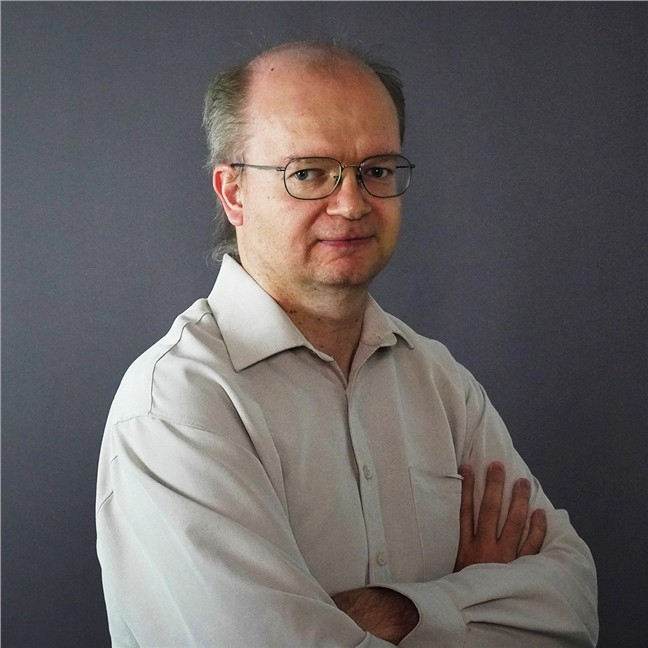
Seniorforsker
Bjørn Fjellvoll
- Avdeling Statistisk modellering av geologi
- Telefonnummer +47 22 85 26 34
- E-post fjellvoll@nr.stage.dekodes.no
Publikasjoner
- 57 publikasjoner funnet
Holden, Lars; Boudko, Svetlana og Fjellvoll, Bjørn. (2026).
Norwegian Historical Population Register, 1801− present.
Holden, Lars; Boudko, Svetlana og Fjellvoll, Bjørn. (2025).
Historisk befolkningsregister som et autoritetsregister for personer og verktøy for lokalhistorisk forskning.
Vis sammendrag
Historisk befolkningsregister (HBR) er et autoritetsregister over alle personene i norsk personhistorisk kildemateriale tilbake til 1801 og gjør det mulig å identifisere og gjenfinne personene i disse kildene. Hver person får en unik ID som er viktig for dokumentasjon og for å finne mer informasjon om vedkommende. HBR utvider perioden med detaljert kunnskap om hver person i den norske befolkningen fra 60 år i dagens folkeregister til 224 år, fra to til syv generasjoner. I denne artikkelen beskriver vi oppbyggingen av HBR med lenkingsstrategier samt personvern og hvordan det avviker fra andre befolkningsoversikter. Videre blir det drøftet hvordan man kan oppnå best mulig kvalitet i registeret, samt representativitet og hvor høy lenkingsgrad det er mulig å oppnå. Kunnskap om hver enkelt persons livsløp, bosted og familie gir en ny innsikt i befolkningen og åpner for nye forskningsmetoder og mer presise beskrivelser og analyser. Dette vises ved å gi et datagrunnlag for migrasjon 1910–1920 og en analyse av fødselsdatoer i folketellinger. Forskere vil kunne trekke ut data om de problemstillinger de interesserer seg for, som grunnlag for sin egen forskning.
Kjønsberg, Heidi; Barker, Daniel Martin L; Fjeldstad, Torstein Mæland; Fjellvoll, Bjørn; Hauge, Ragnar; Nilsen, Carl-Inge Colombo; Røe, Per; Sanchis, Charlotte Juliette; Solberg, Eilif og Abrahamsen, Petter. (2025).
GIG annual meeting 2025 - Summary of 2024 and planned work for 2025.
NVA
Rapport
Barker, Daniel Martin L; Fjeldstad, Torstein Mæland; Fjellvoll, Bjørn; Hauge, Ragnar; Kjønsberg, Heidi; Nilsen, Carl-Inge Colombo; Røe, Per; Semin-Sanchis, Charlotte Juliette; Solberg, Eilif og Abrahamsen, Petter. (2024).
PCube User Manual Version 10.5.
NVA
Rapport
Aker, Eyvind; Barker, Daniel Martin L; Fjeldstad, Torstein Mæland; Fjellvoll, Bjørn; Hauge, Ragnar; Kjønsberg, Heidi; Nilsen, Carl-Inge Colombo; Røe, Per; Semin-Sanchis, Charlotte Juliette og Abrahamsen, Petter. (2024).
GIG annual meeting 2024 - summary of 2023 and planned work for 2024.
NVA
Rapport
Fjellvoll, Bjørn; Hauge, Ragnar; Kjønsberg, Heidi og Semin-Sanchis, Charlotte Juliette. (2024).
Testing the multimodal outside window approximation on two datasets using PCube+.
NVA
Rapport
Lilleborge, Marie; Hauge, Ragnar; Fjellvoll, Bjørn og Abrahamsen, Petter. (2024).
Using Pattern Counts to Quantify the Difference Between a Pair of Three-Dimensional Realizations.
Vis sammendrag
When comparing different ways of modeling discrete three-dimensional realizations such as facies, it is useful to have a measure of difference (or similarity) in the geometry of these realizations.We propose a method for evaluating such difference by comparing pattern counts for a small template. Tests on synthetic datasets demonstrate that the proposed difference effectively differentiates between realizations of a Boolean model and those generated using multiple-point statistics with the Boolean realizations as training images. We also observed that multiple-point statistics realizations based on similar training images yield smaller differences to one another compared to those based on training images from dissimilar concepts. This suggests that the proposed difference is a useful tool for comparing discrete three-dimensional realizations.
Aker, Eyvind; Barker, Daniel Martin L; Kjønsberg, Heidi; Nilsen, Carl-Inge Colombo og Fjellvoll, Bjørn. (2023).
Improved reservoir property inversion and QC.
NVA
Rapport
Aker, Eyvind; Barker, Daniel Martin L; Fjeldstad, Torstein Mæland; Fjellvoll, Bjørn; Hauge, Ragnar; Kjønsberg, Heidi; Nilsen, Carl-Inge Colombo; Røe, Per; Semin-Sanchis, Charlotte Juliette og Abrahamsen, Petter. (2023).
PCube reference manual.
NVA
Rapport
Aker, Eyvind; Barker, Daniel Martin L; Fjeldstad, Torstein Mæland; Fjellvoll, Bjørn; Hauge, Ragnar; Kjønsberg, Heidi; Nilsen, Carl-Inge Colombo; Røe, Per; Semin-Sanchis, Charlotte Juliette og Abrahamsen, Petter. (2023).
PCube User Manual version 10.0.
NVA
Rapport
Lilleborge, Marie; Fjellvoll, Bjørn; Hauge, Ragnar og Abrahamsen, Petter. (2021).
Assessing Multiple-Point Statistics by use of pattern counts to compare images.
NVA
Rapport
Fjellvoll, Bjørn; Hauge, Ragnar; Vazquez, Ariel Almendral; Abrahamsen, Petter og Skauvold, Jacob. (2019).
Applied Geostatistics and Geomodelling 2019. Equinor
NVA
Faglig foredrag
Aarnes, Ingrid; Vegt, Helena van der; Hauge, Ragnar; Fjellvoll, Bjørn og Nordahl, Kjetil. (2019).
Utilizing sedimentary process-based
models as training images for
multipoint facies simulations.
Vis sammendrag
Geostatistical facies modeling algorithms are used in reservoir modeling workflows to create geological models which improve the predictive power of the flow simulation models. In heterogeneous reservoirs, it is of key importance to not only apply statistical techniques, but also incorporate prior geological knowledge. Fluvial dominated deltaic deposits can show a high degree of heterogeneity arising from the interaction of stacking of lobate deposits and the continuous erosion and deposition of the distributary channels while building the delta. To simulate these depositional structures, honouring the physical laws of nature, process-based models can be used to generate synthetic deposits. However, such results are driven by physics and therefore cannot be steered to honour exact well data. We address this challenge by integrating physics-driven process-based models with statistical techniques from MPS. Combining these two different methods is MPS relies on discreet geometric patterns. This is addressed by classifying the process-based model results into discreet facies. A major advantage of this integrated technique is the potential to generate multiple MPS training images through simulation of additional process-based model realizations and we also analyze the effect of using one versus multiple process-based models as input. In this work, we show how the best aspects of both process-based models and MPS modeling can be combined to create improved geological models.
Hauge, Ragnar; Vigsnes, Maria; Fjellvoll, Bjørn; Vevle, Markus Lund og Skorstad, Arne. (2017).
Object-Based Modeling with Dense Well Data.
Vis sammendrag
Although object models are popular with geologists due to their ability to control the geometries that are produced, they tend to have convergence issues when conditioning on complex well patterns. In this paper, we present a new well conditioning algorithm that utilizes more local data when generating channels. We show that this algorithm performs better than the currently commercially available state-of-the-art object model and thus makes object models viable in modern mature field well settings.
Zdanowicz, Hanna Marta; Vigsnes, Maria; Fjellvoll, Bjørn og Hauge, Ragnar. (2017).
Prototype Turbidite Modelling.
NVA
Rapport
Aarnes, Ingrid; Fjellvoll, Bjørn og Hauge, Ragnar. (2017).
Utilizing process-based models in facies modelling workflows.
NVA
Rapport
Aarnes, Ingrid; Fjellvoll, Bjørn; Vegt, Helena van der og Nordahl, Kjetil. (2017).
Using sedimentary process models to assist reservoir facies modeling.
NVA
Faglig foredrag
Fjellvoll, Bjørn; Abrahamsen, Petter; Hauge, Ragnar og Vazquez, Ariel Almendral. (2016).
Geostatistics course. Statoil
NVA
Faglig foredrag
Hauge, Ragnar; Vigsnes, Maria; Fjellvoll, Bjørn; Vevle, Markus Lund og Skorstad, Arne. (2016).
Object-based modelling with dense well data.
NVA
Vitenskapelig foredrag
Fjellvoll, Bjørn; Hauge, Ragnar; Abrahamsen, Petter og Almendral-Vazquez, Ariel. (2015).
Four days course in Geostatistics and Advanced Geomodelling. Norsk Regnesentral
NVA
Faglig foredrag
Dahle, Pål; Nesvold, Erik; Fjellvoll, Bjørn; Georgsen, Frode; Hauge, Ragnar; Kolbjørnsen, Odd; Syversveen, Anne Randi og Ulvmoen, Marit. (2013).
CRAVA User Manual version 2.0.
NVA
Rapport
Fjellvoll, Bjørn. (2013).
TISimCreator -Creating a 3D training image from a 2D training image.
NVA
Rapport
Kolbjørnsen, Odd; Stien, Marita; Kjønsberg, Heidi; Fjellvoll, Bjørn og Abrahamsen, Petter. (2013).
Using Multiple Grids in Markov Mesh Facies Modeling.
Vis sammendrag
A multigrid Markov mesh model for geological facies is formulated by defining a hierarchy of nested grids and defining a Markov mesh model for each of these grids. The facies probabilities in the Markov mesh models are formulated as generalized linear models that combine functions of the grid values in a sequential neighborhood. The parameters in the generalized linear model for each grid are estimated from the training image. During simulation, the coarse patterns are first laid out, and by simulating increasingly finer grids we are able to recreate patterns at different scales. The method is applied to several tests cases and results are compared to the training image and the results of a commercially available snesim algorithm. In each test case, simulation results are compared qualitatively by visual inspection, and quantitatively by using volume fractions, and an upscaled permeability tensor. When compared to the training image, the method produces results that only have a few percent deviation from the values of the training image. When compared with the snesim algorithm the results in general have the same quality. The largest computational cost in the multigrid Markov mesh is the estimation of model parameters from the training image. This is of comparable CPU time to that of creating one snesim realization. The simulation of one realization is typically ten times faster than the estimation.
Kolbjørnsen, Odd; Ulvmoen, Marit; Hauge, Vera Louise; Hauge, Ragnar; Fjellvoll, Bjørn; Jensen, Erling Hugo; Johansen, Tor Arne; Dvorkin, Jack; Mavko, Gary; Furre, Anne-Kari og Johnston, David. (2013).
Monitoring Geological CO2 storage. Gassnova, Norges forskningsråd
NVA
Poster
Dahle, Pål; Fjellvoll, Bjørn; Georgsen, Frode; Hauge, Ragnar; Kolbjørnsen, Odd; Syversveen, Anne Randi og Ulvmoen, Marit. (2012).
CRAVA User Manual version 1.2.
NVA
Rapport
Dahle, Pål; Fjellvoll, Bjørn; Georgsen, Frode; Hauge, Ragnar; Kolbjørnsen, Odd; Syversveen, Anne Randi og Ulvmoen, Marit. (2012).
CRAVA User Manual version 1.1.
NVA
Rapport
Fjellvoll, Bjørn. (2012).
Zonal Anisotropy: Different variogram in the lateral -and in the vertical direction.
NVA
Rapport
Abrahamsen, Petter; Fjellvoll, Bjørn; Hauge, Ragnar og Kolbjørnsen, Odd. (2011).
Geostatistics course.
NVA
Faglig foredrag
Kjønsberg, Heidi; Stien, Marita; Fjellvoll, Bjørn; Kolbjørnsen, Odd og Abrahamsen, Petter. (2011).
Methods of the Markov Mesh Multi-Grid Module in RMS.
NVA
Rapport
Dahle, Pål; Fjellvoll, Bjørn; Georgsen, Frode; Hauge, Ragnar; Kolbjørnsen, Odd; Syversveen, Anne Randi og Ulvmoen, Marit. (2011).
CRAVA User Manual version 1.1.
NVA
Rapport
Røe, Per; Georgsen, Frode; Syversveen, Anne Randi og Fjellvoll, Bjørn. (2010).
Havana technical documentation - Version 6.0.
NVA
Rapport
Dahle, Pål; Fjellvoll, Bjørn; Hauge, Ragnar; Kolbjørnsen, Odd; Syversveen, Anne Randi og Ulvmoen, Marit. (2010).
CRAVA USer Manual version 0.9.6.
NVA
Rapport
Fjellvoll, Bjørn. (2010).
Zonal Anisotropy - Different variogram in the lateral -and in the vertical direction.
NVA
Rapport
Kjønsberg, Heidi; Fjellvoll, Bjørn; Abrahamsen, Petter; Kolbjørnsen, Odd og Stien, Marita. (2009).
Methods of the Multipoint Module in RMS.
NVA
Rapport
Abrahamsen, Petter; Fjellvoll, Bjørn; Kolbjørnsen, Odd og Skorstad, Arne. (2009).
Geostatistics course.
NVA
Faglig foredrag
Fjellvoll, Bjørn; Hammer, Hugo Lewi; Kolbjørnsen, Odd og Skorstad, Arne. (2008).
Geostatistics course.
NVA
Faglig foredrag
Abrahamsen, Petter; Fjellvoll, Bjørn; Hauge, Ragnar; Howell, John og Aas, Tor Even. (2008).
TuMod – Process Based Stochastic Modelling of Deep Marine Deposits.
NVA
Vitenskapelig foredrag
Fjellvoll, Bjørn; Abrahamsen, Petter; Hauge, Ragnar; Howell, John og Aas, Tor Even. (2008).
Stochastic modelling of deep marine deposits by mimicking sedimentary processes.
NVA
Vitenskapelig foredrag
Manzocchi, T; Carter, JN; Skorstad, Arne; Fjellvoll, Bjørn; Stephen, KD; Howell, JA; Matthews, JD; Walsh, JJ; Nepveu, M; Bos, C; Cole, J; Egberts, P; Flint, S; Hern, C; Holden, Lars; Hovland, H; Jackson, H; Kolbjørnsen, Odd; MacDonald, A; Nell, PAR; Onyeagoro, K; Strand, J; Syversveen, Anne Randi; Tchistiakov, A; Yang, C; Yielding, G og Zimmerman, RW. (2008).
Sensitivity of the impact of geological uncertainty on production from faulted and unfaulted shallow-marine oil reservoirs: objectives and methods.
NVA
Vitenskapelig artikkel
Vis sammendrag
Estimates of recovery from oil fields are often found to be significantly in error, and the multidisciplinary SAIGUP modelling project has focused on the problem by assessing the influence of geological factors on production in a large suite of synthetic shallow-marine reservoir models. Over 400 progradational shallow-marine reservoirs, ranging from comparatively simple, parallel, wave-dominated shorelines through to laterally heterogeneous, lobate, river-dominated systems with abundant low-angle clinoforms, were generated as a function of sedimentological input conditioned to natural data. These sedimentological models were combined with structural models sharing a common overall form but consisting of three different fault systems with variable fault density and fault permeability characteristics and a common unfaulted end-member. Different sets of relative permeability functions applied on a facies-by-facies basis were calculated as a function of different lamina-scale properties and upscaling algorithms to establish the uncertainty in production introduced through the upscaling process. Different fault-related upscaling assumptions were also included in some models. A waterflood production mechanism was simulated using up to five different sets of well locations, resulting in simulated production behaviour for over 35 000 full-field reservoir models. The model reservoirs are typical of many North Sea examples, with total production ranging from c. 15×106 m3 to 35×106 m3, and recovery factors of between 30% and 55%. A variety of analytical methods were applied. Formal statistical methods quantified the relative influences of individual input parameters and parameter combinations on production measures. Various measures of reservoir heterogeneity were tested for their ability to discriminate reservoir performance. This paper gives a summary of the modelling and analyses described in more detail in the remainder of this thematic set of papers.
Howell, John Anthony; Skorstad, Arne; MacDonald, Alister; Fordham, Alex; Flint, Stephen; Fjellvoll, Bjørn og Manzocchi, Tom. (2008).
Sedimentological parameterization of shallow-marine reservoirs.
NVA
Vitenskapelig artikkel
Vis sammendrag
The key causes of heterogeneity within progradational shallow-marine reservoirs have been defined as: shoreline type (wave vs. fluvial dominated); shoreline trajectory; the presence of permeability contrasts associated with dipping clinoform surfaces within the shoreface or delta front; the presence of cemented barriers between parasequences; and the progradation direction of the shoreline (described with respect to the main waterflood direction in the simulated reservoir). These parameters were recorded from a series of 56 modern and ancient depositional systems from a variety of climatic and tectonic settings. These data were then used to build the 408 synthetic sedimentological models that formed the basis for the SAIGUP study.
Aas, Tor Even; Hauge, Ragnar; Fjellvoll, Bjørn; Abrahamsen, Petter; Howell, John Anthony og Tucker, Steven. (2007).
Process based modelling of deep marine reservoir systems.
NVA
Vitenskapelig foredrag
Vis sammendrag
Preserved sedimentary and reservoir architecture is function of accommodation, sediment supply and depositional process. Recent advances in numerical, process based modelling have allowed the recreation of flow and deposition within single turbidity events. However, such simulations are computationally very expensive and unsuitable for re-creating reservoirs which are comprised of the results of hundreds of flow events.
A new method for combining a simplified simulation of event based sedimentation in turbidites is presented. Physical processes are simplified while still account for seabed topography, gravity, fluid friction, kinematics, ocean currents, sedimentation and erosion rates. Individual events start in a confined feeder channel and experience a hydraulic jump where the flow stalls and widens into a lobe. Modeling individual events is very fast and hundreds can be simulated. This method is combined with stochastic elements to allow reservoir uncertainty modeling and conditioning to well data.
The basic inputs are paleobathymetry and well data. Paleobathymetry is derived from structural restoration and decompaction of key surfaces. The complete workflow has been tested on two datasets. The Early Cretaceous Kopervik Sandstone from the Outer Moray Firth, North Sea comprises a sand-rich, series of fill and spill deposits sourced from the west. The trend contains a number of important fields and numerous leads. The second dataset is from the Eocene-Oligocene Peira Cava turbidite system which crops out the Alpine foreland in southeastern France. The basin fill architecture comprises proximal scour-and-fill facies deposited in a syndepositional syncline. These datasets have been used to test this new modeling approach.
Abrahamsen, Petter; Fjellvoll, Bjørn; Kolbjørnsen, Odd; Skorstad, Arne og Hauge, Ragnar. (2007).
Geostatistics course.
NVA
Faglig foredrag
Soleng, Harald Heimtun og Fjellvoll, Bjørn. (2007).
Iksim documentation User's Manual and Programmer's Guide.
NVA
Rapport
Abrahamsen, Petter; Fjellvoll, Bjørn; Hauge, Ragnar; Howell, John og Aas, Tor Even. (2007).
Stochastic modelling of deep - marine deposits.
NVA
Vitenskapelig foredrag
Abrahamsen, Petter; Fjellvoll, Bjørn; Hauge, Ragnar; Howell, John Anthony og Aas, Tor Even. (2007).
Process Based Stochastic Modeling of Deep Marine Reservoirs. EAGE
NVA
Vitenskapelig foredrag
Aas, Tor Even; Howell, John; Fjellvoll, Bjørn; Abrahamsen, Petter og Hauge, Ragnar. (2007).
A process based attempt to re-create the Peïra Cava sub-basin, SE France.
NVA
Vitenskapelig foredrag
Skorstad, Arne; Kolbjørnsen, Odd; Fjellvoll, Bjørn; Howell, John Anthony; Manzocchi, Tom og Carter, Jonathan N.. (2005).
Sensitivity of oil production to petrophysical heterogeneities.
NVA
Vitenskapelig kapittel/konferanseartikkel
Howell, John; Skorstad, Arne; Fjellvoll, Bjørn; Kolbjørnsen, Odd; MacDonald, Alister; Fordham, Alex; Stephen, Karl D.; Flint, Stephen; Manzocchi, Tom; Walsh, John J. og Carter, Jonathan N.. (2005).
Sedimentological controls on production with the SAIGUP project.
NVA
Vitenskapelig foredrag
Skorstad, Arne; Kolbjørnsen, Odd; Fjellvoll, Bjørn; Howell, John; Carter, Jonathan N. og Manzocchi, Tom. (2004).
Quantifying sedimentological controls on reservoir performance in prograding shallow marine systems.
NVA
Fagartikkel
Fjellvoll, Bjørn; Gjerde, Jon; Hollund, Knut Utne og Soleng, Harald Heimtun. (2004).
Pilot projects in Havana 2003.
NVA
Rapport
Skorstad, Arne; Fjellvoll, Bjørn; Carter, Jonathan N.; Howell, John; Manzocchi, Tom og Stephen, Karl D.. (2003).
Quantifying structural, stratigraphic and production variability in faulted shallow marine reservoirs.
NVA
Vitenskapelig foredrag
Kolbjørnsen, Odd; Fjellvoll, Bjørn; Skorstad, Arne og Holden, Lars. (2003).
Analysing the influence of structural factors on oil production in shallow marine hydrocarbon reservoirs.
NVA
Vitenskapelig foredrag
Skorstad, Arne og Fjellvoll, Bjørn. (2002).
Managing the SAIGUP senitivity study using RMS Workflow Management and IPL.
NVA
Vitenskapelig foredrag
Fjellvoll, Bjørn; Skorstad, Arne; Howell, John og MacDonald, Alister. (2002).
Modelling dipping clinoform barriers constrained to Facies:Belts.
NVA
Vitenskapelig foredrag